Dr Juliet McGrattan is former GP turned health writer, international speaker, award-winning author and health and menopause coach. She’s been the resident Health Expert for Women’s Running magazine for over a decade and is the Women’s Health Lead, Master Coach and UK Club Director for 261 Fearless, a global, non-profit network which empowers women through running and education.
Juliet’s third book The Runner’s Guide to Menopause: Your essential toolkit for strong, happy and healthy training is published by Bloomsbury. Juliet’s mission is to break down the health barriers that stop women leading active lives.
Link: https://drjulietmcgrattan.com
Why Muscle and Strength Matter for Long Term Health
The Ancient Greek physician Galen first recognised that muscles were controlled by the nervous system, and contracting and relaxing them resulted in movement. We now know that muscles are independent organs, controlling many bodily functions and communicating with other organs around the body. It’s this growing understanding of muscle, beyond basic movement, which has made us realise the important role muscles play in health, especially as we age.
Muscles for good health
During exercise, muscles release hundreds of chemical messengers called myokines into your circulation. Some myokines, such as interleukin-6 (IL-6), act as anti-inflammatories. Many medical conditions such as heart disease, cancer and dementia are caused, or sped up by a low grade inflammation in the body called chronic systemic inflammation. If you are regularly active, your muscles produce lots of myokines, inflammation levels in the body will be lower and your risk of many health conditions reduces. Myokines also have a role in metabolism and insulin sensitivity and this is one of the ways that exercise can help to reduce the risk of type 2 diabetes.
The bad news
The problem is that we reach our peak muscle mass around age 35 and after that we experience a gradual, age-related muscle loss of up to one per cent per year. This happens to men and women, does not significantly increase around menopause but does speed up from around age 65. If we do nothing, our muscle mass will reduce leading to sarcopenia, a state of low muscle mass which results in frailty. Reduced muscle mass also results in increased inflammation in the body and therefore a higher risk of major health conditions.
The good news
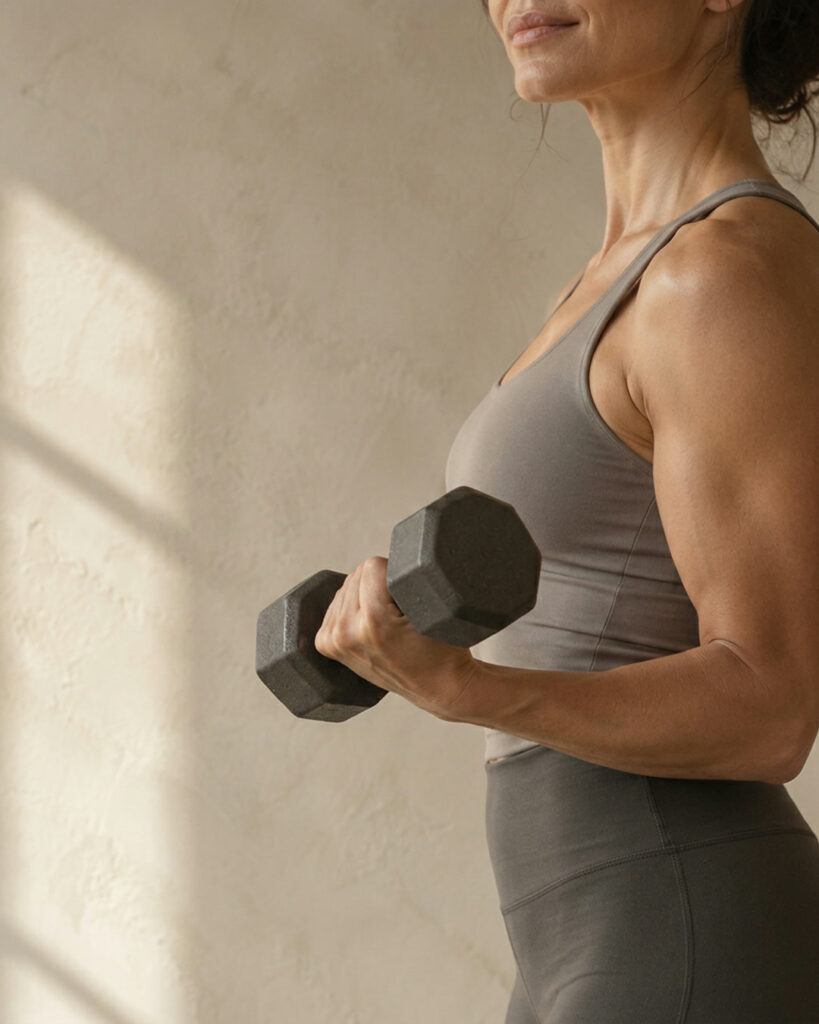
Fortunately, we can reduce our risk of sarcopenia, frailty and ill health with regular strength exercises. Starting with body weight and then progressing to resistance bands or weights will prevent muscle loss and build strength and muscle mass. Strength work becomes something we do for long term health and longevity rather than purely aesthetics. A study from 2022 found that people who do 90 to 120 minutes of strength work each week had around a 13 per cent lower risk of dying from any cause. Having strong muscles also reduces the risk of falls and bone fractures. Strong muscles provide stability and absorb impact and resistance exercises also increase bone mass. Avoiding frailty means a greater chance of living a full and independent life.
As I always say, ‘Feeling strong is empowering. Being strong can change your life’.
Ref:
Momma H, Kawakami R, Honda T, et al
Muscle-strengthening activities are associated with lower risk and mortality in major non-communicable diseases: a systematic review and meta-analysis of cohort studies
British Journal of Sports Medicine 2022;56:755-763.